


In advertising, audience fatigue is real. People see the same ad image repeatedly, engagement drops, and your cost per click climbs. The solution is creative volume: you need multiple ad variations to keep your audience engaged and your algorithms happy. But creating dozens of ad creatives manually is expensive and slow. AI ad generation solves this bottleneck completely.
Wanoza AI gives you the creative output of an entire agency team in minutes. This guide shows you exactly how to generate high-performing ad variations at scale, test what resonates with your audience, and optimize your advertising ROI without increasing your creative budget.
Why Ad Creative Volume Matters
Modern advertising platforms reward fresh creative. Facebook, Instagram, Google, and TikTok algorithms prioritize ads that generate engagement. When your audience sees the same image repeatedly, engagement declines, and the platform shows your ad less frequently. This creates a vicious cycle: lower engagement leads to lower reach, which requires higher bids to maintain visibility.
AI breaks this cycle by making creative volume affordable. Instead of creating 3-5 ad variations per campaign, you can create 30-50. This gives you more data to identify what works, reduces audience fatigue, and keeps your cost per acquisition stable over time.
Testing Different Creative Angles
The biggest mistake advertisers make is guessing which creative angle will work. You think luxury packaging will appeal to your audience, but they actually respond better to lifestyle context. AI lets you test multiple angles simultaneously without expensive photoshoots.
How to test creative angles with Product Shot Generator:
- Identify your hypothesis: What creative angle do you want to test? (e.g., luxury vs. nature vs. urban)
- Generate variations: Create 3-5 versions of the same product with different backgrounds and styling
- Launch as A/B tests: Run all variations simultaneously with equal budget allocation
- Measure performance: Track click-through rate, conversion rate, and cost per acquisition for each variation
- Scale winners: Allocate more budget to top-performing creatives, pause underperformers
Example creative angle test for a skincare product:
- Idea A - Luxury: Product on marble surface, gold accents, soft studio lighting
- Idea B - Natural: Product on moss, wooden tray, natural window light
- Idea C - Urban: Product on concrete, minimalist aesthetic, dramatic shadows
- Idea D - Scientific: Product in lab setting, beakers and test tubes, clinical lighting
- Idea E - Lifestyle: Product on bathroom counter, morning routine context
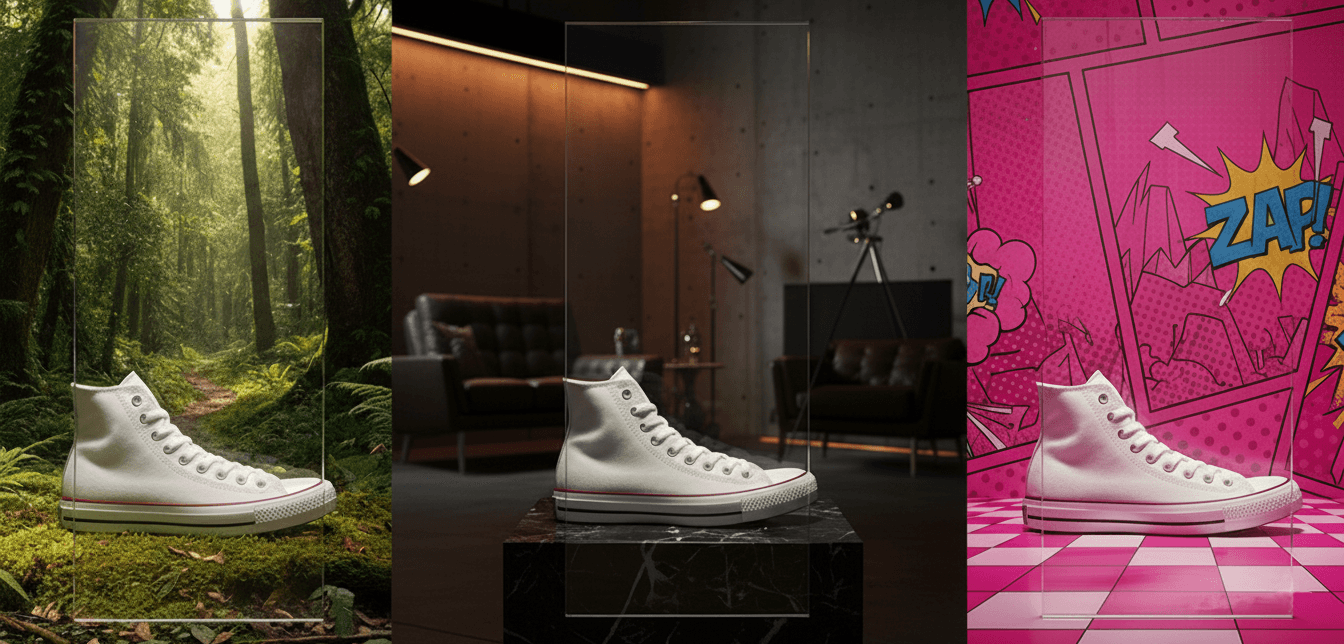
Run all five variations for one week. The data will tell you which angle resonates with your audience—not your assumptions. This data-driven approach consistently outperforms gut-based creative decisions.
Creating Ads with Embedded Text
Historically, AI struggled with text generation. Letters would appear as squiggles, words would be misspelled, and typography would look amateurish. This changed with models like Ideogram V3, which can now generate legible, well-styled text directly within images.
Why embedded text matters for ads:
- Higher engagement: Text overlays capture attention in crowded feeds
- Faster comprehension: Viewers understand your offer in 2-3 seconds
- Platform optimization: Many users watch videos without sound; text ensures your message lands
- Testing flexibility: Test different headlines, offers, and calls-to-action without design work
Effective text-based ad prompts:
- "Product photo with bold text overlay '50% OFF TODAY' in modern sans-serif font"
- "Lifestyle image with handwritten text 'New Collection' in corner"
- "Minimalist design with centered text 'Free Shipping' and brand logo"
- "Dynamic action shot with text 'Limited Time Offer' in high-contrast color"
Pro tip: When testing text variations, keep the visual elements identical. This isolates the impact of the text itself. Test "50% OFF" vs. "BUY ONE GET ONE" vs. "FREE SHIPPING" on the exact same product image to see which offer drives the most clicks.
Localization: Adapting Visuals for Global Markets
Global brands often make the mistake of using the same ad creative everywhere. A winter coat ad shot in New York appears in Tokyo. A beer commercial featuring a German pub runs in Australia. This approach is cheap but ineffective—visual context matters as much as language translation.
AI makes visual localization affordable and scalable. Instead of expensive reshoots for each market, you can adapt existing creatives to match local culture, aesthetics, and context.
How to localize ad creatives with AI:
- Start with your base creative: Your proven-performing ad from your home market
- Identify localization elements: Background, models, props, cultural context
- Generate market-specific versions: Use prompts that incorporate local visual cues
- Review for cultural appropriateness: Have local team members verify the adaptations
- Launch and measure: Track performance by market to refine your approach
Real-world localization examples:
- Germany: Cozy pub interior, wooden tables, traditional beer steins
- Australia: Sunny beach, outdoor bar, casual atmosphere
- Japan: Izakaya setting, minimalist design, group dining context
- Brazil: Vibrant street festival, colorful decorations, energetic mood
- France: Parisian café, elegant presentation, sophisticated aesthetic
This "multi-local" approach builds stronger connections with each market while maintaining brand consistency. Your core message stays the same; only the visual context adapts to feel native to each audience.
Building an Ad Creative System
Successful advertisers don't create ads one at a time. They build systems for generating, testing, and optimizing creative at scale. Here is a practical workflow:
Weekly creative generation session:
- Monday morning: Block 2 hours for creative generation
- Review performance data: Identify top-performing creatives from last week
- Generate variations: Create 3-5 new versions of each winning creative
- Test new angles: Generate 5-10 completely new creative concepts
- Organize assets: Save all creatives in a structured folder system
Ongoing optimization cycle:
- Launch new creatives: Add 10-15 new ads to your rotation each week
- Monitor performance: Check metrics after 3-5 days of data
- Scale winners: Increase budget for top 20 percent of creatives
- Pause losers: Stop spending on bottom 30 percent of creatives
- Iterate: Use insights from winners to inform next generation
Measuring Creative Performance
Volume without measurement is wasted effort. Track these key metrics for each ad creative:
- Click-through rate (CTR): Percentage of viewers who click your ad
- Conversion rate: Percentage of clicks that result in desired action
- Cost per acquisition (CPA): How much you spend to acquire one customer
- Return on ad spend (ROAS): Revenue generated per dollar spent
- Frequency: How many times average user sees your ad (watch for fatigue)
Use these metrics to make data-driven decisions about which creatives to scale and which to retire. The goal is not just more creatives—it is more effective creatives.
Common Mistakes to Avoid
- Skipping the testing phase: Don't assume you know what will work. Test everything.
- Changing too many variables at once: Isolate one element per test (headline, image, offer)
- Ignoring frequency caps: Even great creatives fatigue. Rotate them regularly.
- Forgetting mobile optimization: Most ads are viewed on phones. Ensure text is readable at small sizes.
- Neglecting brand consistency: All variations should still feel like your brand.
Getting Started Today
You do not need a massive creative team or huge budget to implement this approach. Start small:
- Pick one product or service you are currently advertising
- Generate 5-10 creative variations using AI tools
- Launch them as a small test campaign ($50-100 budget)
- Measure performance after one week
- Scale the winners, learn from the data, repeat
The barrier to sophisticated ad creative testing has never been lower. The question is not whether you can afford to test multiple creatives. The question is whether you can afford not to, when your competitors are already doing it.
Ready to scale your ad creative production? Start generating high-performing ad variations today.